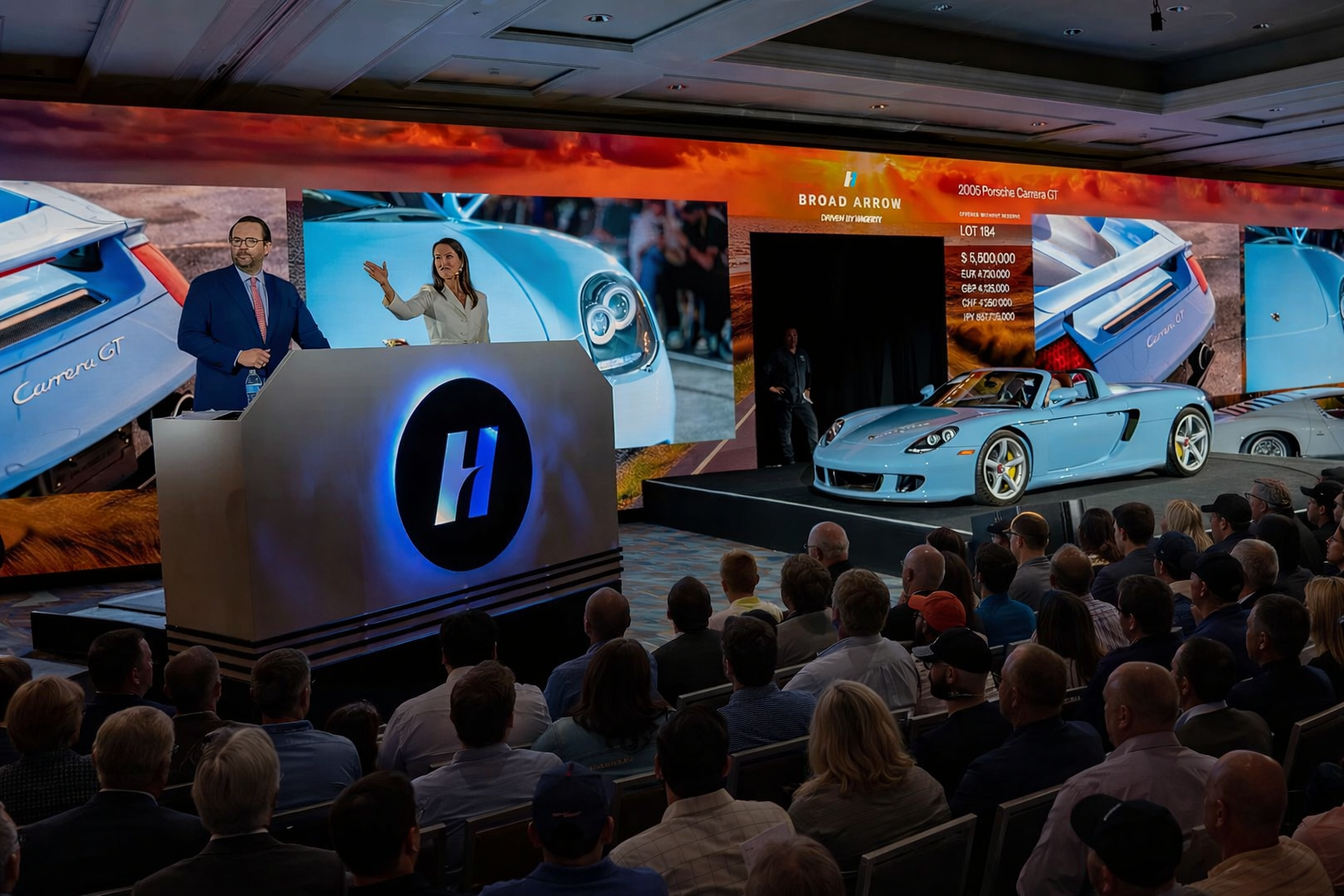
Listen. I’ve spent most of my life shouting at cars, and usually, those cars are doing something I like, such as sliding sideways through a cloud of their own vaporized tires. But lately, I’ve been looking at the auction results for the icons of the early 2000s, and I’ve started to wonder if the world hasn’t finally, collectively, lost its mind.
Take the Ferrari Enzo. For nearly a decade, it sat in a sort of polite financial waiting room. It was as flat as a pancake, much like the price of gold before everyone realized the world was ending. But then, almost overnight, the graph performed a vertical takeoff. In early 2026, we’ve seen a Giallo Modena Enzo shatter records at $17.87 million. The Porsche Carrera GT, once a bargain at $600,000, has just obliterated the $6.7 million mark for a Gulf Blue example at Amelia Island.
Naturally, the internet—a place where people go to be angry about things they cannot afford—is screaming that it’s all rigged. They say it’s a conspiracy of shadowy billionaires and auction houses passing the same three cars back and forth to inflate the numbers.
To those people, I have one word: Nonsense.
The Math of the Mundane
Let’s look at the cheap stuff. If you go to a Lamborghini dealership today and ask for their entry level model, the Temerario, you’ll be staring at a bill for $430,000 before you’ve even ticked the box for the floor mats. By the time you’ve added some carbon fiber bits and a paint job that does not look like a rental car, you’re at $500,000.
Now, think about that. That’s a mass produced, turbocharged, hybrid assisted computer with some leather on top. If a common or garden Lambo is half a million, it makes absolutely zero sense for a Ferrari Enzo—a car with a naturally aspirated V12, Formula 1 DNA, and a nose designed by a man who clearly liked spaceships—to be anywhere near the same price.
The Hybrid Headache
Then we have the modern hypercars. Cars like the McLaren P1 are engineering marvels, but they come with a terrifying caveat: batteries. If you buy a P1 today and the hybrid system decides to pack up, you are looking at a $160,000 bill just for a replacement battery pack. That is the price of a brand new Porsche 911 Carrera 4S simply to make your McLaren start.
Collectors are realizing that the analogue kings—the Enzo and the Carrera GT—do not have these digital expiration dates. They have engines, gears, and souls. They are mechanical art, not a smartphone on wheels that will eventually become a very expensive brick.
A Decade of Dust and the Special Model Surge
The most important thing to remember is that these cars are not some overnight hype created by a teenager on TikTok. These specific chassis are well known to the community. They have traded hands multiple times over the last decade or longer. I remember when people were bored of the Enzo. I remember when the Carrera GT was considered difficult.
For ten years, these cars suffered through a period of criminal underappreciation. They were flat while the rest of the world moved on. What we are seeing now is not a scam; it is a massive, overdue market correction.
And it is not just the halo cars. Look at the Ferrari Challenge Stradale. A few years ago, you could pick one up for the price of a mid range saloon. Now, we are seeing them hammer at nearly $1 million. The 430 Scuderia and its drop top sibling, the 16M, are following the exact same path, with low mileage 16M examples recently pushing toward $1.1 million. Even the 599 GTO is being pulled into the stratosphere. The market has realized that these special models are the last of their kind.
Dark Pools and the Pikachu Principle
There are people who whisper about dark pool bids and secret deals, but just ask yourself one simple question: Would I rather have an iconic Porsche Carrera GT—the first ever V10 Porsche put into a road car, with a manual gearbox and the ability to make your ears bleed with joy—for a million pounds, or a brand new Lamborghini Revuelto?
The Revuelto is a fine piece of kit, but any prep with a large enough bank balance can walk into a dealership and get one. It’s a commodity. The Carrera GT is a legend. Real collectors want rarity and special things.
In a world where a Pokémon card—literally a 3 inch piece of cardboard featuring a yellow rat—can sell for over $16 million, why on earth would anyone think it is far fetched for a carbon fiber Ferrari with a V12 to fetch the same? At least you can drive the Ferrari. If you try to sit on a Pikachu Illustrator card, it loses half its value instantly.
The Diamond Hand of the Collector
One thing the armchair critics forget is who actually owns these cars. These are not people who are overleveraged or desperate for a quick buck. These collectors have massive excess capital and incredibly diverse portfolios. They are not desperate to unload anytime soon.
After talking with many classic owners, I have realized something: even if their cars reach obscene levels, they have diamond hands. They simply refuse to sell. Why? Because there is nothing else like them out there. If you sell your Carrera GT for six million, what do you buy to replace it? A fleet of turbocharged, modern supercars that sound like sewing machines and feel like video games? I think not. They would rather keep the visceral masterpiece than have more digital zeros in a bank account.
Scarcity and the AutoTrader Delusion
Most people simply do not understand how few of these things actually exist. There are roughly eight billion people on this planet now. There are only 399 Enzos. There are only 1,270 Carrera GTs.
You cannot just go on AutoTrader and find a pristine, low mileage 2000s hypercar. They do not live there. They live in climate controlled vaults, guarded by men with very serious faces. When one of these examples finally breaks cover, the wealthiest people on Earth fall over themselves to grab it because they know they might not get another chance for a decade.
Will the Bubble Pop?
People keep waiting for the bubble to burst, but they do not understand what that would actually require. For the prices of these cars to fall back to reasonable levels, the entire world would have to suffer a catastrophic shock.
I’m talking about a total collapse where every asset—your house, your stocks, your gold—drops by 70%. If the hypercar market pops, it means the global economy has been hit by a metaphorical asteroid. Trust me, if that happens, the price of a Ferrari will be the very last thing on your mind as you are trading your shoes for a tin of beans.
The market is not rigged. It’s finally waking up. And for those of us who love the scream of a naturally aspirated V12, it is about time.